
- Physical complaints
- Types of bone fractures
Types of bone fractures
Types of fractures
Not all bone fractures (fractures) are the same. A bone breaks when the force on it exceeds what it can withstand. This can happen in many ways. There are therefore many different types of bone fractures. The severity ranges from a small crack in the bone to a bone that is completely broken through and out of alignment.
Below is a list of many different types of bone fractures. Many combinations of these fractures are possible. A traumatic fracture can, for example, consist of multiple breaks, be displaced, and open. A stress fracture is usually a hairline fracture that is not displaced and is closed.
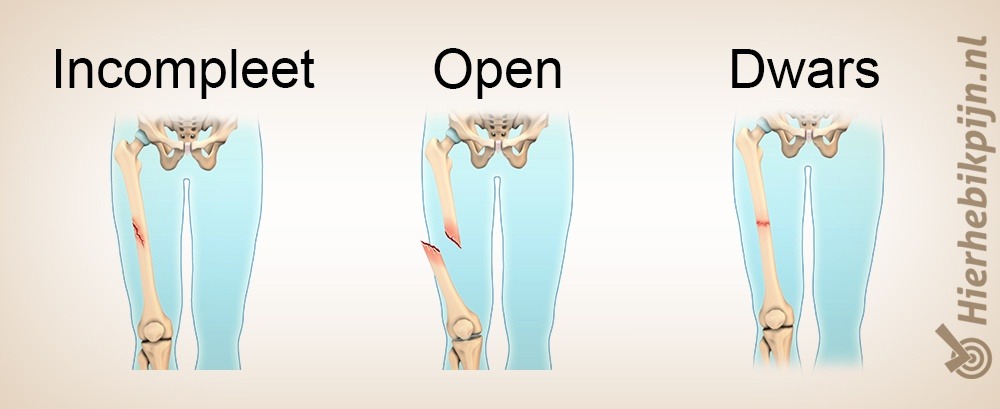
Incomplete fracture
In an incomplete fracture, the bone is not broken all the way through.
Complete fracture
In a complete fracture, the bone is broken all the way through. So there are two or more pieces.
Closed fracture / uncomplicated fracture
In these fractures, the skin is still intact, and no bone protrudes out through the skin.
Open fracture / complicated fracture
An open fracture is a break in which a part of the bone protrudes through the skin. There is a wound present. Because the skin is damaged and dirt can enter the wound, there is a risk of infection. Such a subsequent problem is called a complication.
Unstable fracture
In an unstable fracture there is a high risk that the fracture fragments will displace. Blood vessels, nerves, or other structures can also be damaged as a result. An unstable fracture must no longer be moved or loaded.
Stable fracture
In the case of a stable fracture, the chance that the fracture will worsen and cause greater damage is small.
Non-displaced fracture
A non-displaced fracture is a complete break in which the fracture surfaces of the bone still lie nicely against each other.
Displaced fracture
If a bone breaks completely and the ends of the fracture no longer lie straight opposite each other, then the fracture is displaced.
Transverse fracture
In this fracture, the fracture line runs in a straight line across the bone.
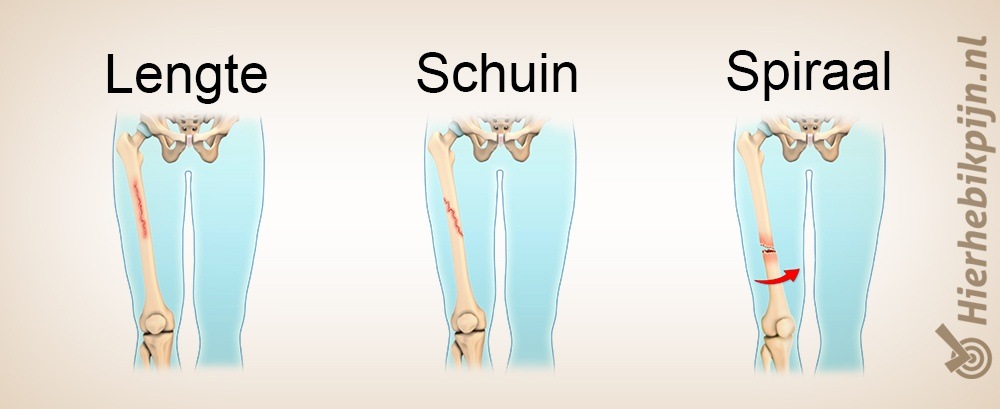
Longitudinal fracture
A longitudinal fracture runs along the length of the bone.
Oblique fracture
An oblique fracture runs diagonally along the length of the bone.
Spiral fracture
In a spiral fracture, one or both parts of the fracture are twisted relative to each other.
Traumatic fracture
Traumatic fractures are breaks as a result of an accident, a hard blow, or a fall.
Non-traumatic fracture
A non-traumatic fracture is not caused by a hard blow, accident, or fall, but by overuse or disease of the bone (see fracture due to bone disease).
Comminuted fracture
In a comminuted fracture there is not one break, but multiple fractures in the same bone. So there are multiple bone pieces and/or bone splinters.
Segmental fracture
The same bone is broken in 2 places; there is a loose segment (part). There is a piece of bone that no longer makes contact with the rest of the bone at either end.
Fracture-dislocation
In a fracture-dislocation, the bone is broken and the associated joint is dislocated.
Avulsion fracture
Here, a small piece of bone has been pulled off or torn away. The tendon or the ligament attached to the bone has pulled so hard on it that a piece of bone has come loose.
Intra-articular fracture
Intra-articular fractures are bone fractures that extend into the joint. The cartilage of the joint is damaged.
Compression fracture
In a compression fracture, the bone collapses. This regularly occurs in the vertebrae of older people.
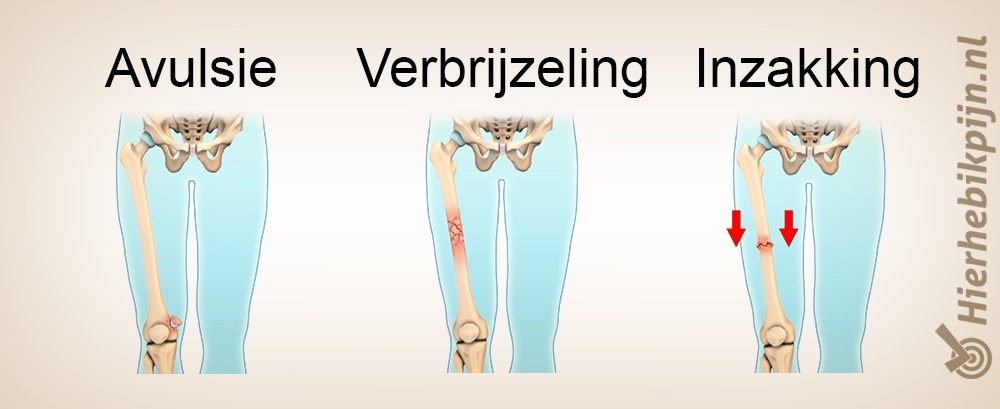
Impacted fracture
A piece of bone has broken off and is driven into another bone (fragment).
Fracture due to bone disease / pathologic fracture / insufficiency fracture
If there is a disease present that has weakened the bone and therefore makes it break more easily, then this is called a pathologic or insufficiency fracture. The bone, for example, is weakened by a tumor, bone cyst, osteoporosis, or another bone disease.
Hairline fracture / fissure
A hairline fracture is a crack in the bone.
Stress fracture
Stress fractures arise from prolonged overuse of the bone. These are usually small cracks or hairline fractures of the bone.
Greenstick fracture
In a greenstick fracture, the bone is bent like a young twig. The bone is broken on one side and still intact on the other.
Torus fracture
In a torus fracture the bone deforms but does not break. The periosteum is still intact.
Growth plate fracture / epiphysiolysis / epiphyseolysis / epiphyseal fracture
A fracture of the growth plate in children.
What can we improve according to you?
Let us know, your opinion is important to us.
Thank you for your feedback!
We will work even harder to improve the quality of Physiocheck.us.
Did this information help you?
Related topics
- Asthma
- Back pain
- Bone fracture
- Bronchitis
- Bursitis
- COPD
- Cervical herniated disc
- Coughing up mucus
- Cracking joints
- Diaphragm pain
- Discopathy
- Emphysema
- Fatigue
- Flat feet
- Floating rib syndrome
- Fluid in the ankle
- Fluid in the knee
- Fracture
- Funnel chest
- Groin pain
- Heel spur
- Herniated disc
- High blood pressure
- High-arched feet
- Hip dysplasia
- Hypermobility
- Iliotibial band friction syndrome
- Impingement syndrome
- Incontinence
- Inflammation
- Knee osteoarthritis
- Lower back pain
- Lumbago
- Muscle Cramp
- Muscle Pain
- Muscle contusion
- Muscle strain
- Obesity
- Overuse
- Pigeon chest
- Pneumonia
- Polymyalgia rheumatica
- Referred pain
- Sarcopenia
- Scapula alata
- Sciatica
- Shortness of breath
- Spondylosis
- Sprained ankle
- Tendinopathy
- Tendon inflammation
- Torn ankle ligament
- Tremor
- Types of bone fractures
- Worn hip