
- Physical complaints
- Fracture
- Stress fracture
Stress fracture
Overuse of the bone, stress fracture
Prolonged overloading of a bone can lead to a break, a so-called stress fracture.
Bone building
Bones are structures in which there is normally a good balance between bone formation and bone resorption. Bone formation depends on bone loading, meaning a bone becomes stronger as it is loaded more. Each load on the bone first causes minimal bone resorption and is then followed by bone formation.
Through bone formation the bone becomes stronger to tolerate a higher load next time. But if the load is too high for too long and there is too little recovery, bone formation no longer occurs.
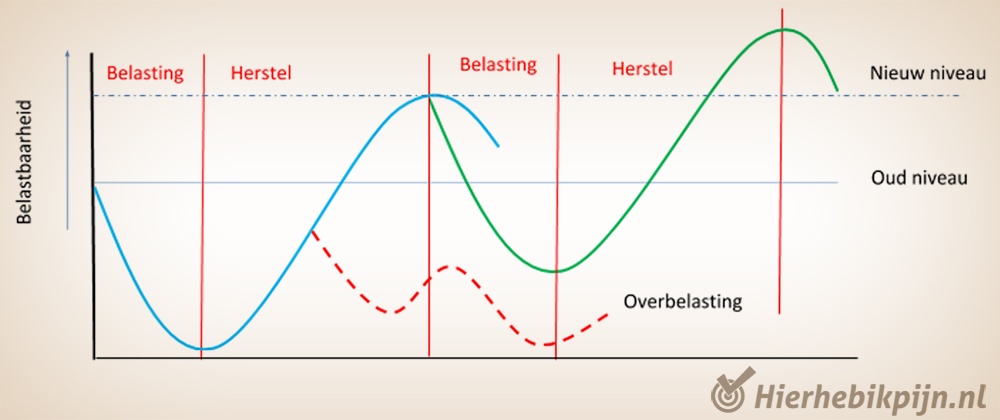
Image: After each load (bone resorption) recovery (bone formation) follows. When too much and/or too rapid loading is applied during recovery (red dotted line), bone formation is impaired. When insufficient recovery occurs over a longer period, a stress fracture develops. How long this period is varies from person to person.
Risk factors for a stress fracture
There are two major risk factors for developing a stress fracture:
- Rapid increase in bone loading (heavier or more training in a short time).
- Energy imbalance. With limited intake of healthy nutrients, there are insufficient building blocks for bone formation.
The location of a stress fracture depends on the sport. Stress fractures of the shoulders and arms occur in sports where the arms are used a lot, such as tennis, swimming, and baseball. While track and field mainly causes stress fractures in the feet and shins. The places where stress fractures most often occur are: shinbone, metatarsals, thighbone, and pelvis. Track and field is the sport with the greatest risk of stress fractures.
Complaints and symptoms of a stress fracture
With a stress fracture, there is localized pain during or after sports. The pain worsens if the athlete continues. The bone is tender to pressure at the location of the stress fracture. This only applies when the bone can be palpated, such as the shinbone, fibula, and metatarsals. For bones that cannot be palpated because there is a lot of muscle tissue around them, different tests exist to examine whether a stress fracture is present.
Diagnosis of a stress fracture
A stress fracture has two grades:
- Low risk of symptom worsening.
- High risk of symptom worsening.
The location of the stress fracture determines whether it belongs to a low- or high-risk category. This is not only dependent on the bone, but especially on the specific spot within the bone. Thus, stress fractures in the same bone can carry either a low or a high risk.
Imaging is necessary for an accurate diagnosis. Options include a röntgenfoto, bone scan, CT scan or MRI scan.
A röntgenfoto is not always sufficient as a diagnostic tool. Stress fractures are often only visible at a later stage on a röntgenfoto. In some cases a stress fracture is not visible at all. This is because bone changes in a stress fracture start inside the bone and are not visible on röntgen. An MRI scan is therefore better for detecting stress fractures.
Treatment of a stress fracture
For low-risk stress fractures, (relative) rest is sufficient. If there is enough compressive load on the bone, such as in the thighbone, healing proceeds well by reducing activities. In addition, low-risk stress fractures are less likely to recur.
When a stress fracture is high risk, the course is often unfavorable. The chance is high that the stress fracture will become a complete fracture. Treatment for high risk may involve a longer period in a cast or even surgery.
Healing of the bone without surgery often occurs within six weeks. After this, sport can be gradually resumed. Progression should be guided by pain (stop immediately if painful) and by tenderness to touch at the fracture site.
Treatment of high-risk stress fractures depends on the form of the fracture and the location. Due to surgery, or prolonged casting, rehabilitation takes much longer. This can take up to a year.
Contact a physical therapist to guide you through the recovery process.
What can we improve according to you?
Let us know, your opinion is important to us.
Thank you for your feedback!
We will work even harder to improve the quality of Physiocheck.us.
Did this information help you?