
- Rehabilitation aids
- Arm sling
Arm sling
Triangular bandage
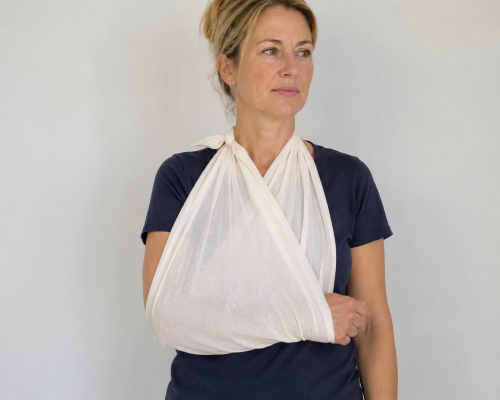
An arm sling supports an injured forearm, wrist, or hand. It is made from a triangular bandage tied around the neck. The injured arm rests in the sling and is relieved of strain.
When do you use an arm sling?
You use an arm sling to support the arm after an injury to the fingers, wrist, or forearm up to the elbow, such as a fracture, large wound, or bruise. The entire forearm, from the elbow to the fingers, rests in the sling, which is tied around the neck.
How do you use an arm sling?
The hand and fingers should be slightly higher than the elbow. This prevents venous congestion, in which blood flows down toward the hand and fingers but cannot drain properly, causing swelling and painful throbbing.
If the problem is higher in the arm or shoulder, a broad sling is better. This band hangs over the shoulder and supports the wrist while leaving the rest of the forearm and elbow free.
If the injury has just occurred and you do not have anything to make a sling, use your healthy arm to support the injured arm.
How do you apply an arm sling?
Applying an arm sling is easy. Follow these steps:
- Step 1: Place the sling against the body and under the injured arm. The point should be at the elbow. The upper part should lie over the shoulder of the uninjured arm.
- Step 2: Take the lower part of the sling and place it over the shoulder of the injured arm.
- Step 3: Tie the ends together with a flat knot where it will not irritate the skin. Fold the point at the elbow forward and secure it with a safety pin or adhesive tape.
- Step 4: Make sure the fingers protrude slightly.
Then check that the sling is comfortable and that the hand is slightly higher than the elbow to prevent congestion.
What can we improve according to you?
Let us know, your opinion is important to us.
Thank you for your feedback!
We will work even harder to improve the quality of Physiocheck.us.
Did this information help you?