
- Anatomy
- Dermatomes
Dermatomes
The body has 31 pairs of spinal nerves. These are nerves that run from the spine to all parts of the body. A dermatome is an area of skin that is supplied by a single specific spinal nerve.
Each nerve corresponds to one (Eén) dermatome. There are 8 pairs of spinal nerves in the neck. This means the nerves from the neck supply 16 dermatomes. The thoracic spine has 12 pairs of spinal nerves and thus 24 dermatomes. The lower back and the sacrum each have 5 pairs of spinal nerves with 10 dermatomes each, and the coccyx has only 1 pair of nerves and thus 2 dermatomes.
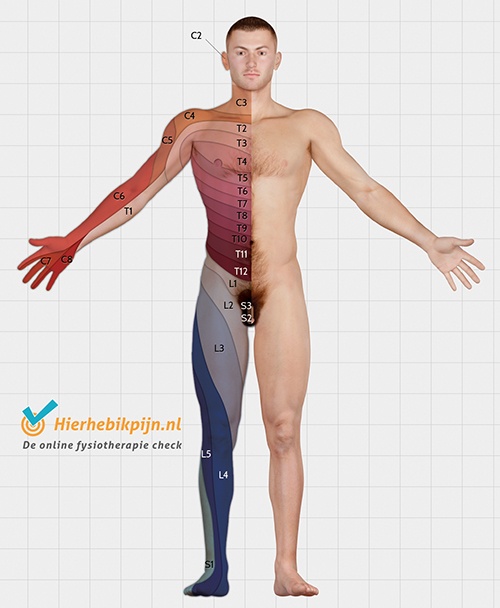
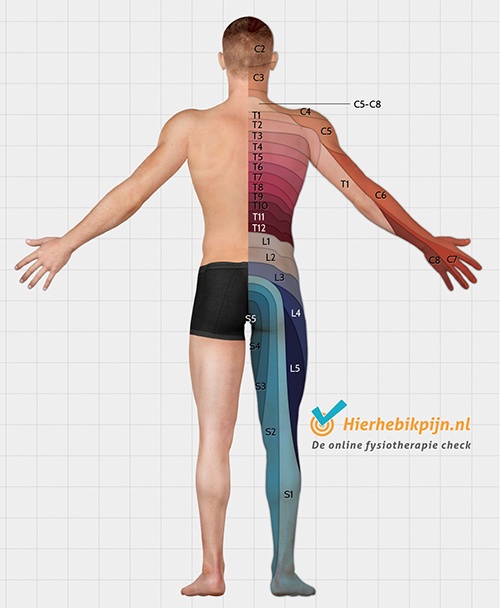
Below is an overview of the dermatomes on the front and back of the body.
Dermatomes front (ventral)
Dermatomes back (dorsal)
Description of the dermatomes per level
| C2 - Temple and occiput. C3 - Area at the level of a sweater collar. C4 - Lower neck and nape. C5 - Outside of the shoulder (deltoïdeus area). C6 - Thumb and index finger. C7 - Middle part of the hand and fingers. C8 - Ring finger and little finger. T1 - Part of the lower and upper arm up to the start of the hand. T2 - Part of the upper arm. T3 - Armpit. T4 - Nipples. T5 - Inframammary fold. T6 / T7 - Xiphoid process of the sternum (processus xiphoïdeus). T10 - Navel (often the first symptom of appendicitis). T12 - Pubic region. L1 - Back, top of the ilium, and groin. L2 - Back, ilium, front of thigh, and scrotum. L3 - Back of the hip, area above the kneecap, and inside of the knee / lower leg. L4 - Area around the kneecap, outer buttock region, outer thigh, front of the lower leg, inside of the foot, beginning of the big toe. L5 - 1st (big) and 2nd toe. S1 - 3rd, 4th, and 5th toe; heel. S2 - Buttock region, inside of the thigh and lower leg, genitals. S3 - Buttock region, back of the thigh, genitals. S4 - Area around the anus. S5 - Anus. |
Arrangement of dermatomes
As seen in the images, the dermatomes of the trunk are stacked in a somewhat logical fashion. In the arms and legs, the dermatomes run more longitudinally. As a result, the dermatomal arrangement of the arms and legs may seem illogical at first.
But if you get down on your hands and feet like a quadruped, the dermatomes turn out to align fairly neatly in one line. After all, we descend from apes and are naturally meant to walk on hands and feet. We only started walking upright later.
Medical significance
A dermatome is supplied by sensory nerves. These nerves belong to a specific nerve root ganglion located just in front of the spine. In this way, it is possible to determine which ganglion corresponds to the symptoms. Symptoms present in a particular dermatome may originate from the associated ganglion.
An example is a herniated disc; this is a compression of a nerve that causes symptoms in the area supplied by the compressed nerve, such as tingling and numbness.
One spinal nerve therefore supplies one specific skin area on one side of the body. In addition, such a nerve (zo’n zenuw) also supplies certain muscles. When such a nerve (zo’n zenuw) is compressed, weakness occurs in the muscles that it innervates. These muscle groups (or portions of them) controlled by a single nerve are called myotomes.
What can we improve according to you?
Let us know, your opinion is important to us.
Thank you for your feedback!
We will work even harder to improve the quality of Physiocheck.us.
Did this information help you?
Related topics
- Achilles Tendon
- Anatomy of the Hand
- Anatomy of the Wrist
- Anatomy of the abdominal muscles
- Anatomy of the bones
- Anatomy of the foot
- Anatomy of the spine
- Anatomy of the thigh
- Big toe
- Bursa
- Cartilage
- Central nervous system
- Connective tissue
- Dermatomes
- Hamstrings
- Intervertebral disc
- Joint
- Joint capsule
- Ligaments
- Lungs
- Motor nerve
- Muscles
- Nervous system
- Osteoarthritis
- Pelvic floor muscles
- Peripheral nervous system
- Proprioception
- Rotator cuff
- SI joint
- Sensory nerve
- Skin
- Subscapularis
- Synovial fluid
- Tendons
- Trapezius muscle
- Trigger points